@thetinmen An advanced guide to: Intimate Partner Violence
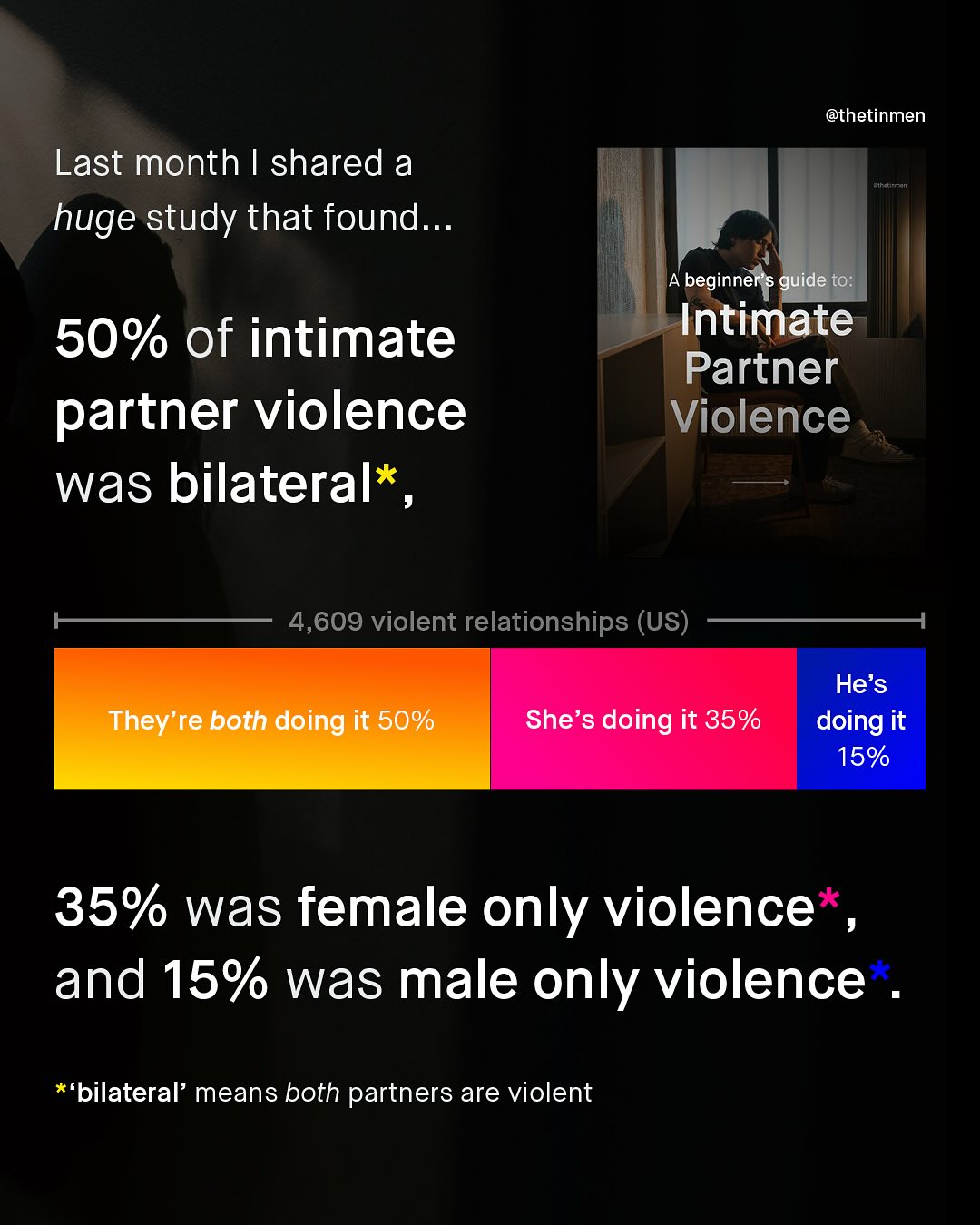
@thetinmen Last month | shared a huge study that found_ beginner"$ guide to: Intimate Partner Violence 50% of intimate partner violence was bilateral 4,609 violent relationships (US) He's doing it 15% They're both doing it 50% She's doing it 35% 35% was female only violence and 15% was male only violence 'bilateral' means both partners are violent
Middler /highschc TABLAIA Kelohanauanet Clarecterstics 64 Antices lncluded Reviely Characterise Shnple5ee Utlieucnet Ha#a Geported nelea 1,573 Senple qype Lirge populetion stues Keeatattileenlt ne Now have new data_ Hollelu Fune @thetinmen Hanneeeennenaldaunonaan =enann AnudElhf Suae Elualerence H Leacenete 'Clinical samples n Ketn AleIea (ousn n]] Ftlan Patter 46132 Volume Number 2023 Bidirectional and Unidirectional Intimate Partner Violence: A Comprehensive Review Alexandra Lysova, PhD Kenzie Hanson, MA Simon Fraser University; Burnaby; BC, Canada Jennifer Mackay; PhD Nottingham Trent University; Nottingham, UK he debate over whether intimate partner violence (IPV) primarily unidirectional by Tnem (male-perpetrated violence against women) or bidir- ectional (both partners engaging violence) remains significant: 2012 systematic reviewv determined the prevalence of bidirectional and unidirec- tional IPV various population samples (Langhinrichsen-Rohling et al 2012)- The current comprehensive review updates the 2012 review, ana lyzing 64 empirical studies directly related to the bidirectionality of physi cal violence between 2012 University/college students n-2,592 unidirectional violence by DmmaIi communin_ univeraby college students addlescent middlehigh echool etdentes Faaa ennanee mentment eelungl andeothher atudy chanactenshicg: mldhtatthestdiret [nieaare nleaeuenenlt Lneeoentile tent[lne Small communi This study breaks down even more partner violence alge data,ton= 3 across various areas and countries, to see if these findings change _
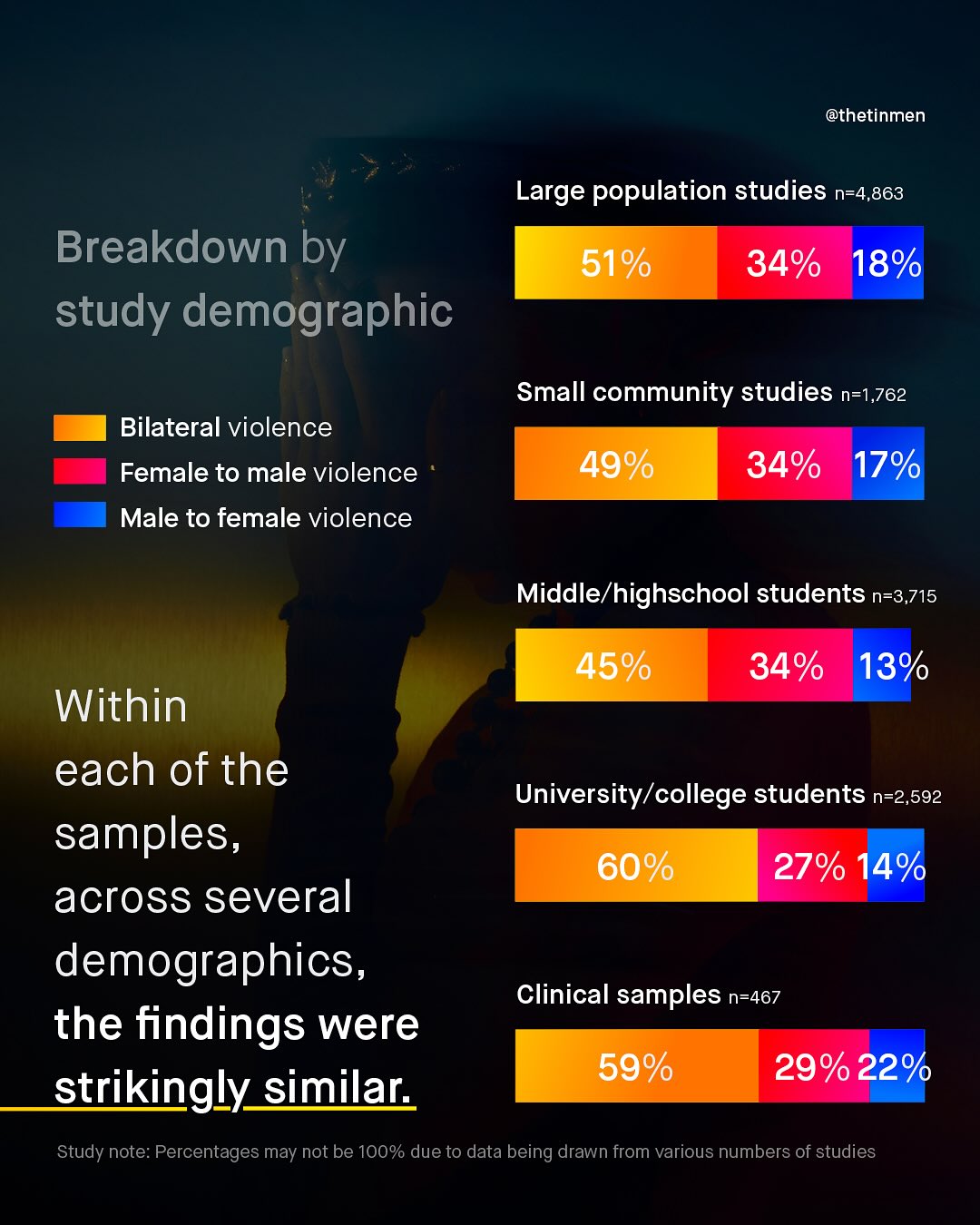
@thetinmen Large population studies n-4,863 Breakdown by 51% 34% 18% study demographic Small community studies n-1,762 Bilateral violence Female to male violence 49% 34% 17% Male to female violence Middle/highschool students n-3,715 45% 34% 13% Within each of the University/college students n-2,592 samples, 60% 27% 14% across several demographics, Clinical samples n-467 the findings were 59% 29% 22% strikingly_similar Study note: Percentages may not be 100% due to data being drawn from various numbers of studies
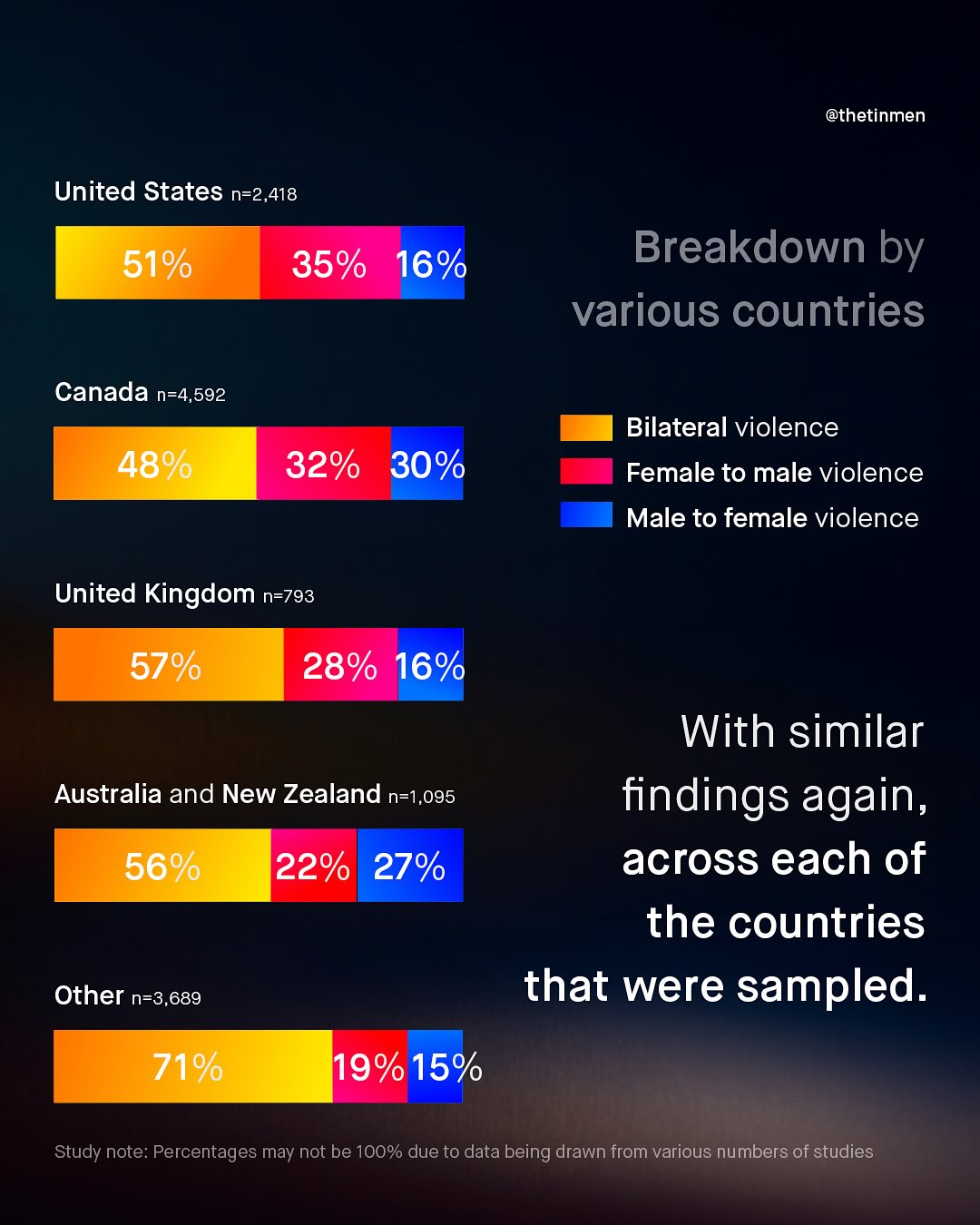
@thetinmen United States n-2,418 51% 35% 16% Breakdown by various countries Canada n-4,592 Bilateral violence Female to male violence Male to female violence 48% 32% 30% United Kingdom n-793 57% 28% 16% With similar Australia and New Zealand n-1,095 findings again, 56% 22% 27% across each of the countries Other n-3,689 that were sampled. 71% 119% 15% Study note: Percentages may not be 100% due to data being drawn from various numbers of studies
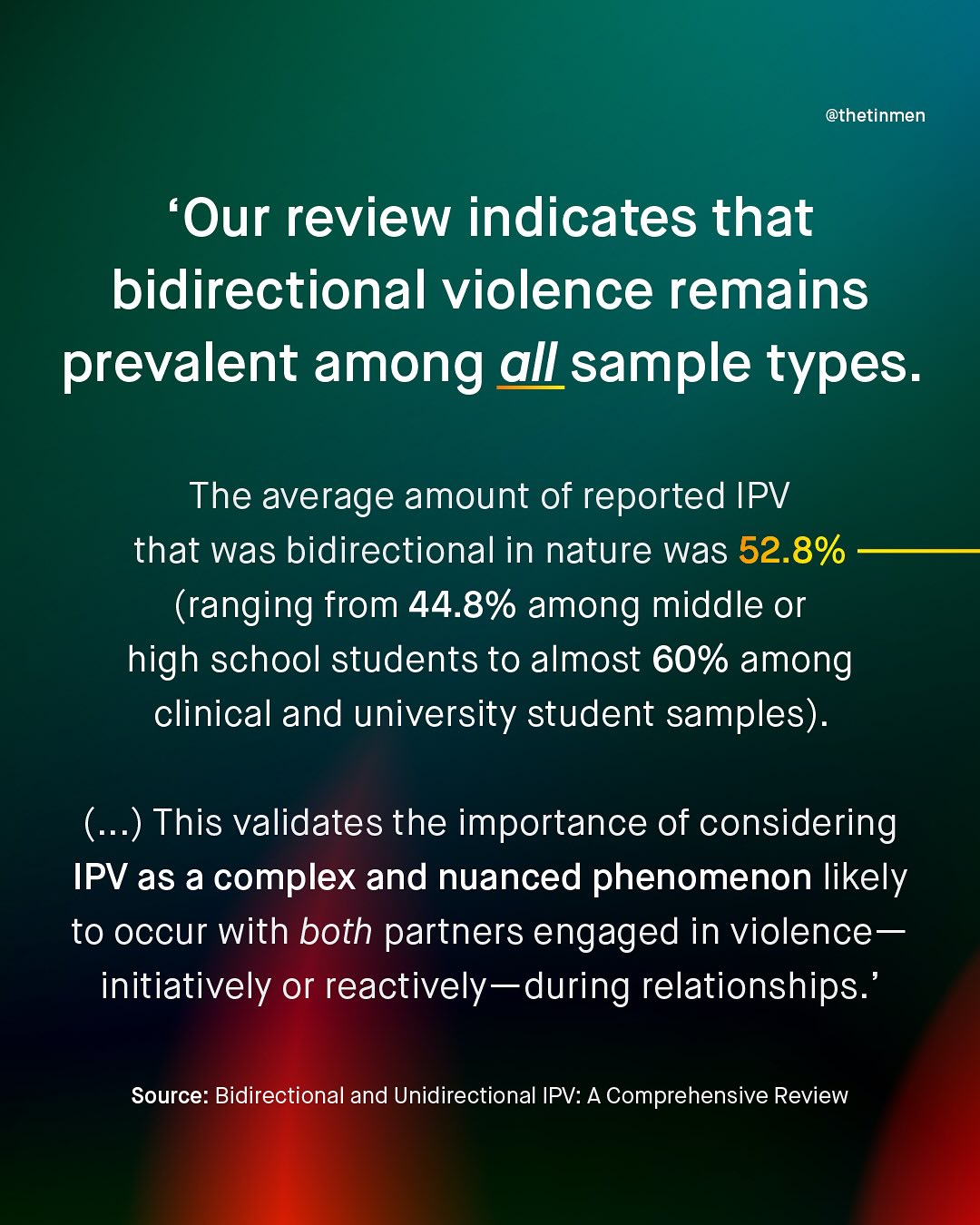
@thetinmen 'Our review indicates that bidirectional violence remains prevalent among allsample types: The average amount of reported IPV that was bidirectional in nature was 52.8% (ranging from 44.8% among middle or high school students to almost 60% among clinical and university student samples): () This validates the importance of considering IPV as a complex and nuanced phenomenon likely to occur with both partners engaged in violence _ initiatively or reactively-_during relationships. = Source: Bidirectional and Unidirectional IPV: A Comprehensive Review
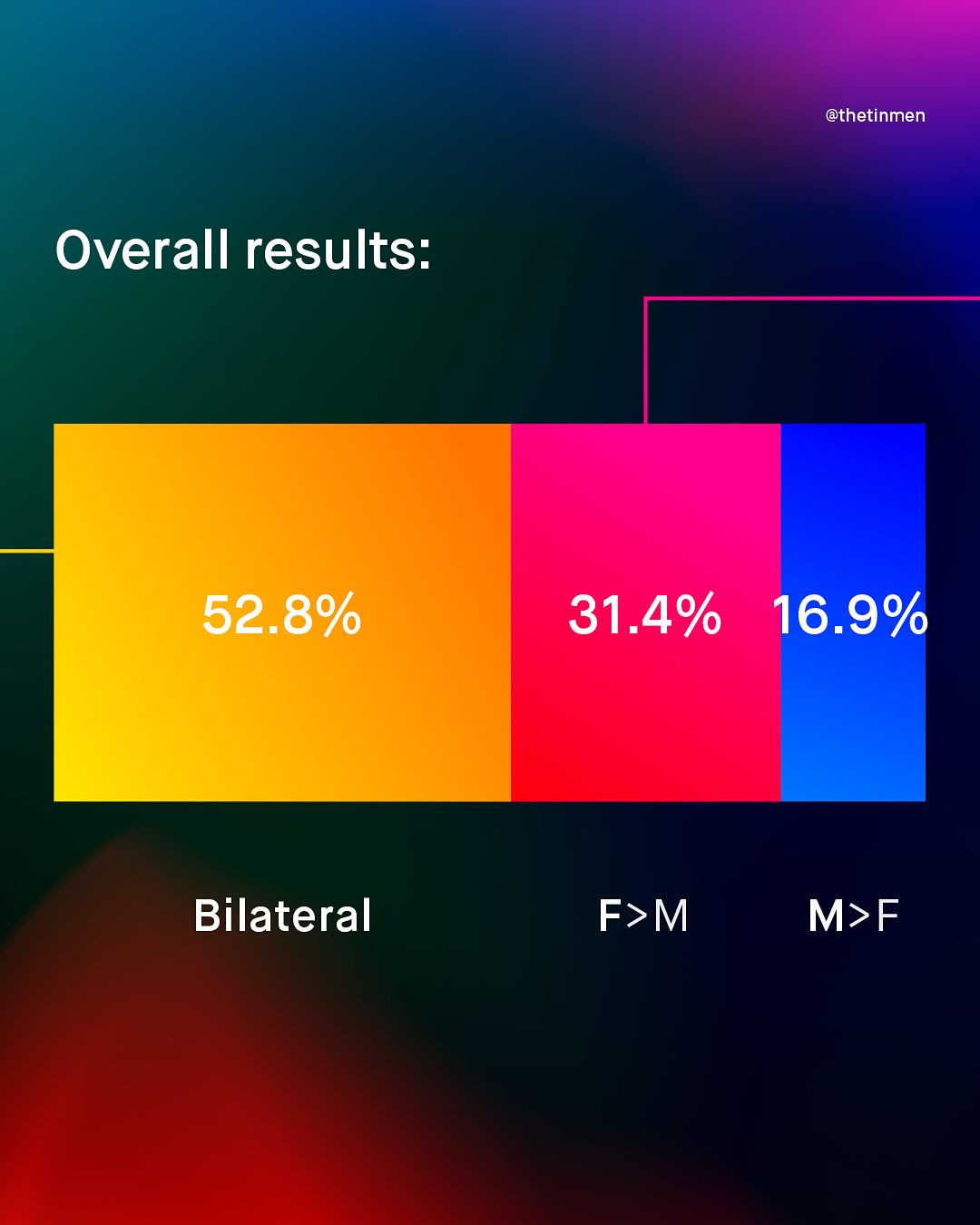
@thetinmen Overall results: 52.8% 31.4% 16.9% Bilateral F>M M>F
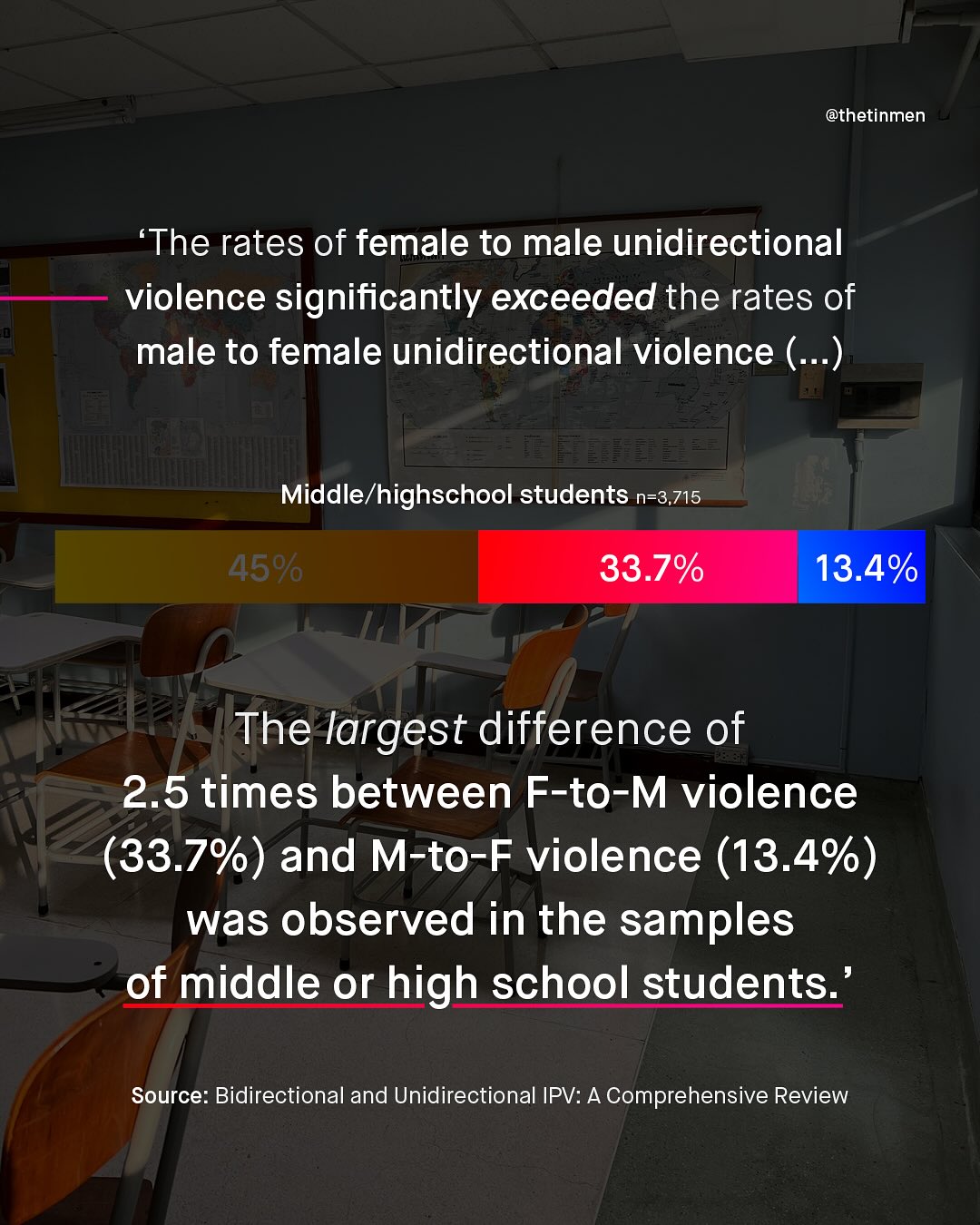
@thetinmen 'The rates of female to male unidirectional violence significantly exceeded the rates of male to female unidirectional violence (..) Middle/highschool students n-3,715 45% 33.7% 13.4% The largest difference of 2.5 times between F-to-M violence (33.7%) and M-to-F violence (13.4%) was observed in the samples of middle or high school students: Source: Bidirectional and Unidirectional IPV: A Comprehensive Review
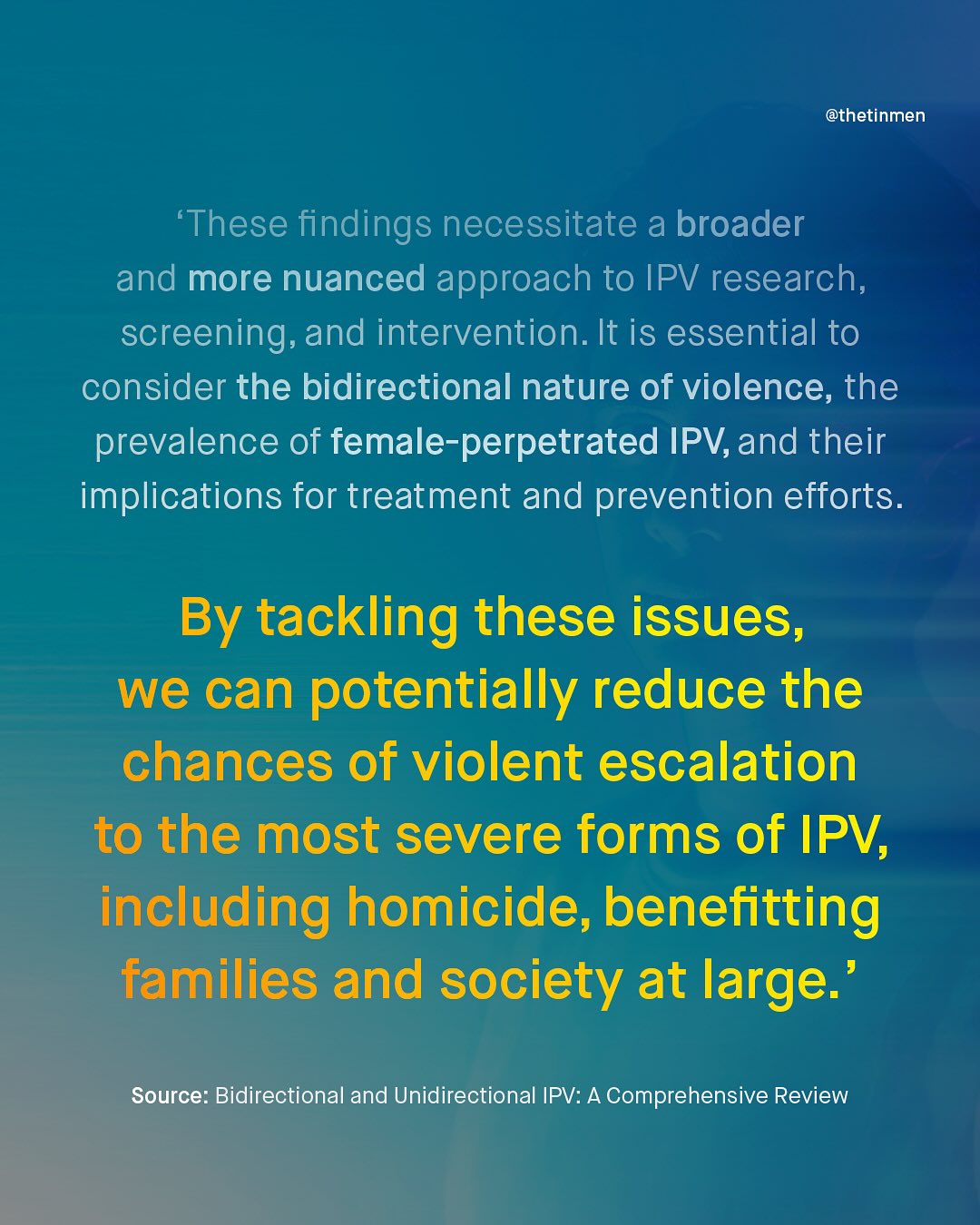
@thetinmen 'These findings necessitate a broader and more nuanced approach to IPV research; screening; and intervention: It is essential to consider the bidirectional nature of violence, the prevalence of female-perpetrated IPV,and their implications for treatment and prevention efforts: By tackling these issues, we can potentially reduce the chances of violent escalation to the most severe forms of IPV; including homicide; benefitting families and society at large: Source: Bidirectional and Unidirectional IPV: A Comprehensive Review
@thetinmen What does partner violence_ really look like? What do you think? @thetinmen
KF This isn't Young men; Why are you giving about youl up on @thetinmen Filtaan Btlteahrnun hvpocritical ula Young ovoryAsinglo houl PATH PATREON Tre cying T NT F nctosefd a VRconroat Mefet ETAi G#tf Hecdlyttenin Aeeenteitt dtoth IS THIS THE SAME patreon com/thetinmen AS SAYING takes ALL LIVES E2 This iS a 'good quc Exclusive content, live steams, MATTER? hot takes, producer credits, and more nlate blindneds Do1 a beginner"s SS man guide to like this man Help support Lcan Ra chonco the prison Eyeleni IS DST @thetinmen BK WH what iS a the iS a "Dro code" TO DIE BY SUICIDE complete privilege that you live by? E? in its Dr Suete BAf Thelnien picture Own rigrt: Executive Producers (Dorothy Tier) ~Stop The gurl UGLY the Nout end + Cool dude + Richard D. Knight + David Maywald Wh 'Get Ryan WP Steve Sweeney ER + Carolina This Knk [ Financtal Abuse? VIOLENCE + Marc Holmes +LHVJR + Conal McFadyen + Bursi + Steven P Men; what would Men; what ung was you love to do; makes you feel WITHOUT rhero VuC wrong misunderstood WORDS by women? FOR

I recently shared a post about intimate partner violence, based on data from the infamous, and enormous 2007 Whittaker study on 18,760 (!) relationships, that found: 50% of intimate partner violence was bilateral (with both partners doing it), 35% was female to male violence, and 15% was male to female. This makes “male violence”, which dominates advocacy and our airwaves, the least common form of IPV. These are certainly controversial findings, but I must admit, the data is rather old now. Luckily, one of my many talented followers, who is a family violence researcher, has replicated the study, this time with new data, from various countries, and samples around the world. I wanted to share the data; and how, yes, it’s more-or-less the same again. Most shocking to me, was the biggest disparity in unilateral violence was seen in middle/high school samples, where girls were 2.5 TIMES (!) more likely to be unilaterally violent than boys. This surely shines new light on why BOTH girls and boys should be taught about the dangers of IPV, and BOTH girls and boys should be protected from it. So, will this study, and its additional tens of thousands of surveyed participants, spanning several countries, do anything to change the warped, ideological narrative of IPV, that causes so much harm? What do you think? ~ Source https://tinyurl.com/yh9erb23

2025-11-05

Last viewed category: